Source: Charles Darwin, The Voyage of the Beagle (1839), Chapter II — public domain (Project Gutenberg eBook #944). Reused here only to exercise the piece template's components; it is not a real dataset piece.
Excursion north of Cape Frio
APRIL 4th to July 5th, 1832.--A few days after our arrival I became acquainted with an Englishman who was going to visit his estate, situated rather more than a hundred miles from the capital, to the northward of Cape Frio. I gladly accepted his kind offer of allowing me to accompany him.
April 8th.--Our party amounted to seven. The first stage was very interesting. The day was powerfully hot, and as we passed through the woods, everything was motionless, excepting the large and brilliant butterflies, which lazily fluttered about. We arrived by midday at Ithacaia; this small village is situated on a plain, and round the central house are the huts of the negroes. As the moon rose early, we determined to start the same evening for our sleeping-place at the Lagoa Marica.
April 9th.--We left our miserable sleeping-place before sunrise. The road passed through a narrow sandy plain, lying between the sea and the interior salt lagoons. We dined at Mandetiba; the thermometer in the shade being 84 degs. As the venda1 here was a very good one, and I have the pleasant, but rare remembrance, of an excellent dinner, I will be grateful and presently describe it, as the type of its class. These houses are often large, and are built of thick upright posts, with boughs interwoven, and afterwards plastered. Yet the host of this venda, being asked if he knew anything of a whip which one of the party had lost, gruffly answered, "How should I know? why did you not take care of it?--I suppose the dogs have eaten it."
"How should I know? why did you not take care of it?--I suppose the dogs have eaten it."
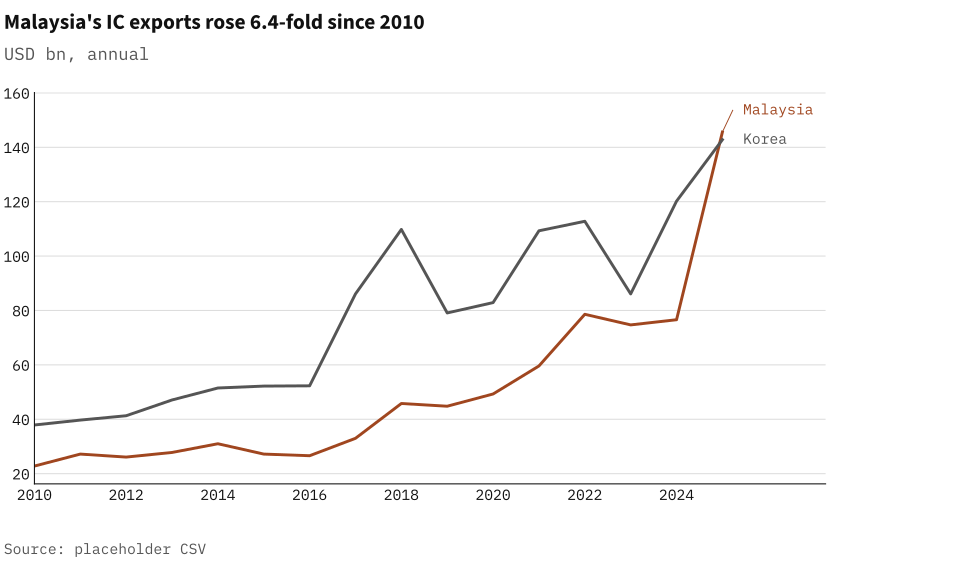
| Year | Malaysia (USD bn) | Korea (USD bn) |
|---|---|---|
| 2010 | 22.8 | 37.9 |
| 2011 | 27.2 | 39.7 |
| 2012 | 26.1 | 41.3 |
| 2013 | 27.8 | 47.1 |
| 2014 | 31.0 | 51.5 |
| 2015 | 27.2 | 52.2 |
| 2016 | 26.6 | 52.3 |
| 2017 | 33.0 | 86.1 |
| 2018 | 45.8 | 109.8 |
| 2019 | 44.8 | 79.1 |
| 2020 | 49.3 | 82.9 |
| 2021 | 59.6 | 109.3 |
| 2022 | 78.6 | 112.8 |
| 2023 | 74.7 | 86.1 |
| 2024 | 76.6 | 120.2 |
| 2025 | 145.6 | 142.8 |
Lagoons, shells, and the vampire bat
Leaving Mandetiba, we continued to pass through an intricate wilderness of lakes; in some of which were fresh, in others salt water shells. M. Gay2 has stated that he found in the neighbourhood of Rio, shells of the marine genera solen and mytilus, and fresh water ampullariae, living together in brackish water.
Leaving the coast for a time, we again entered the forest. The trees were very lofty, and remarkable, compared with those of Europe, from the whiteness of their trunks. The Vampire bat is often the cause of much trouble, by biting the horses on their withers. The injury is generally not so much owing to the loss of blood, as to the inflammation which the pressure of the saddle afterwards produces. We were bivouacking late one evening near Coquimbo, in Chile, when my servant, noticing that one of the horses was very restive, went to see what was the matter, and fancying he could distinguish something, suddenly put his hand on the beast's withers, and secured the vampire.